
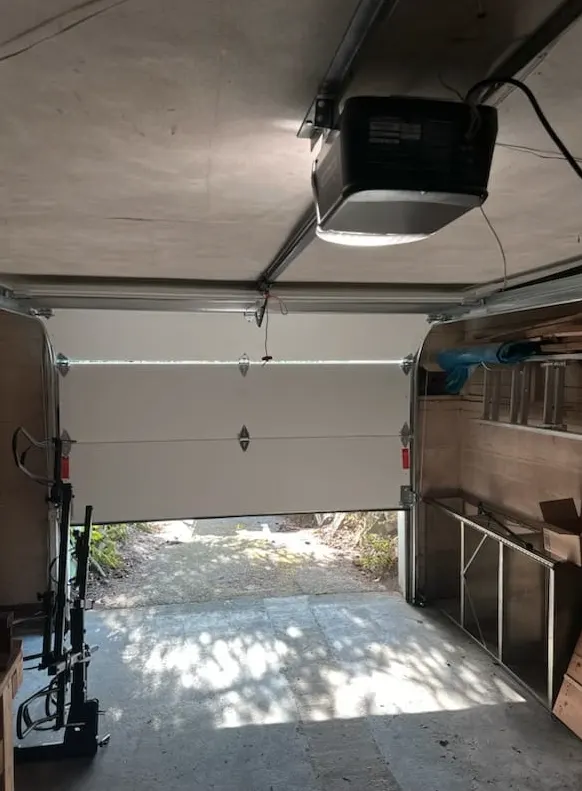
What a Season of Noise Really Costs You
A garage door opener that bangs, grinds, or rattles every time it runs isn't just annoying — it's telling you something is working harder than it should. Ignore it through another humid summer and a rough hurricane season, and that loose chain or worn trolley doesn't fix itself. It wears the gear inside the motor housing, stresses the J-arm connection, and eventually leaves you with a dead opener instead of a loud one. A $10 bottle of lubricant and twenty minutes today is a lot cheaper than a full opener replacement later, which nationally can run anywhere from a few hundred to over a thousand dollars depending on the unit.
Diagnose Before You Reach for Tools
Not all opener noise is the same, and fixing the wrong part wastes time. Listen for a few seconds before the door even moves:
- A loud clunk at start or stop: usually loose mounting hardware or a loose J-arm bracket.
- A steady rattling along the rail: often a dry or stretched chain, or a loose rail bracket.
- A humming or straining motor with little door movement: can point to a worn trolley, a bent rail, or a door that's harder to lift than it should be — a job for a technician, not a lubricant.
- Vibration that travels into the house: frequently a mounting issue, not the opener itself.
Tools You'll Need
- A step ladder tall enough to reach the opener rail comfortably
- A socket set or adjustable wrench
- A Phillips and flathead screwdriver
- White lithium grease or a silicone-based garage door lubricant (not WD-40 or motor oil — both attract grit and gum up in humid air)
- A rag and a small wire brush for cleaning the rail and chain
- Rubber anti-vibration pads or isolators, available at most hardware stores
The Fix-It Ladder: Work Through These in Order
- Tighten every bolt you can reach. Start at the motor mounting bracket, then the rail supports, then the J-arm where it connects to the door. Vibration loosens hardware over time, and this alone solves a surprising amount of opener noise.
- Clean and lubricate the chain or belt and rail. Wipe off old grease and dust with a rag, then apply a thin coat of white lithium grease along the full length of the rail. Avoid over-lubricating — excess grease just collects grit, especially with sandy coastal dust in the mix.
- Check chain or belt tension. Most openers have a tensioning bolt near the motor unit. The chain or belt should have a small amount of sag — check your owner's manual for the exact spec. Too tight strains the motor; too loose causes slapping and rattling.
- Install vibration isolators. Rubber pads or isolator kits between the motor mount and the ceiling bracket absorb a lot of the noise that otherwise transmits through your framing.
- Inspect the trolley and carriage. Look for cracked plastic, worn rollers inside the carriage, or a trolley that wobbles side to side. A worn trolley is a cheap part but awkward to replace without disconnecting the chain correctly.
- Check the door's own hardware. Loose hinges, dry rollers, or a bent track upstream of the opener will make the opener work harder and sound worse, even if the opener itself is fine.
- Consider a belt-drive conversion. If you've worked through every step above and the unit is still loud — or if the chain-drive opener is more than eight or ten years old — swapping to a belt-drive system is often the real fix. Belt drives run significantly quieter and don't need the same chain lubrication routine, which matters in a climate where grease, grit, and moisture mix constantly.
What You Can Safely Do vs. What Needs a Technician
Tightening hardware, lubricating the rail, wiping down the chain, and adding vibration isolators are all reasonable weekend tasks for most homeowners. Where it's worth stopping and calling in help:
- Adjusting travel limits or force settings on the opener's circuit board
- Replacing the trolley, carriage, or drive chain/belt assembly itself
- Diagnosing a straining motor that may be struggling to lift a heavier or off-balance door
- Converting from chain-drive to belt-drive, which usually means remounting the rail and motor unit correctly
A door that's out of balance or has failing springs will make any opener work harder and louder — and that's a job that involves high-tension parts best left to a trained technician.
Why Opener Noise Builds Faster Here
Salt air near the coast speeds up rust on exposed chain links and mounting hardware, even on openers tucked inside a garage. Humidity swells wood doors and door components, adding resistance that the opener has to push through on every cycle. And after a summer of afternoon downpours and storm-driven wind loads, hardware that was snug in spring is often looser by fall. None of that is unique to one neighborhood — it's just how equipment ages in this part of Florida, which is why a noisy opener in November is worth addressing before cooler, drier months make it easy to ignore.
When to Call St. Augustine Garage Door Experts
If you've worked through the list above and the noise hasn't improved, or if you're hearing straining, grinding from deeper in the mechanism, or your opener is old enough that parts are hard to source, it's time to call in a technician. Our team handles both Garage Door Opener Installation for a full belt-drive swap and Garage Door Maintenance & Tune-Up visits that catch loose hardware, worn trolleys, and chain tension issues before they turn into a dead motor. We'll inspect the whole system — opener, track, rollers, and door balance — so you're not just quieting a symptom.
If your garage door opener has been getting louder by the week, give St. Augustine Garage Door Experts a call. We serve St. Augustine, St. Augustine Beach, Ponte Vedra Beach, Vilano Beach, and the surrounding St. Johns County area, and we can get your opener running quietly again before the noise gets worse.