
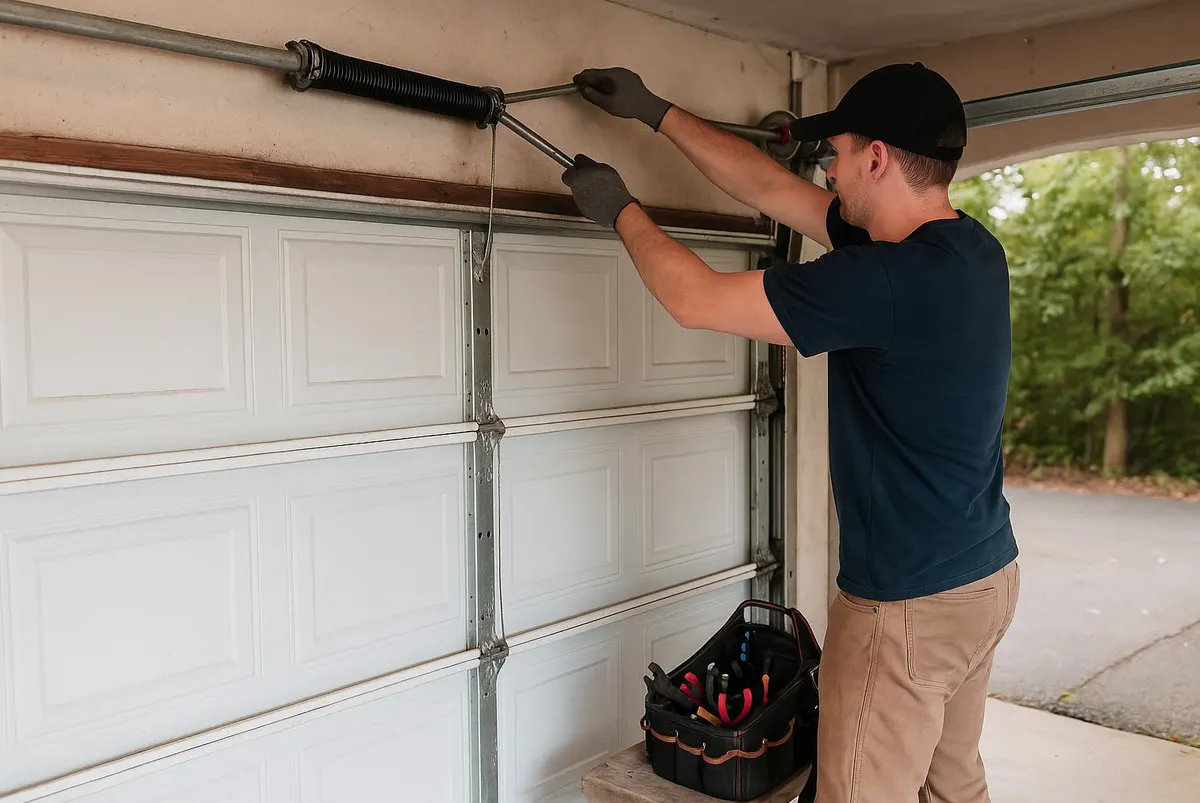
The Call That Comes In Every Week
A technician pulls up to find the homeowner standing in the driveway, pressing the remote over and over. The door starts down, stops a few inches from the floor, and reverses back up. Sometimes it won't move at all except to climb and then reverse immediately. Nine times out of ten, the culprit is sitting about six inches off the ground on each side of the track: the photo-eye safety sensors, and they're either dirty, knocked out of alignment, or both.
In this part of Florida, that's not a coincidence. Humidity fogs the lenses, salt air corrodes the brackets, and afternoon downpours leave water spots right on the glass. Add in lawn crews, bikes, and coolers getting bumped against the sensor brackets near the floor, and it's easy to see why this is one of the most common no-close complaints technicians handle here.
What the Sensors Actually Do, and What Happens When They Fail
The two small sensors mounted near the bottom of each track send an invisible infrared beam across the garage door opening. If something breaks that beam, like a pet, a bike, or a person, the door is supposed to stop and reverse instead of coming down on it. This is a federally mandated safety feature on residential garage door openers built since the mid-1990s, and it exists because garage doors are heavy enough to cause serious injury or worse.
When the sensors get dirty, misaligned, or wired incorrectly, two things can happen. The safer failure mode is that the door simply refuses to close, or closes partway and reverses, which is annoying but harmless. The dangerous failure mode is a sensor that's been bypassed or disconnected so the door closes every time, no matter what's in the way. That second scenario is where real injuries happen, and it's avoidable.
Why Sensors Trip More Often Here
- Moisture and condensation: Humid mornings and sudden afternoon storms can leave a thin film of moisture on the lens, scattering the infrared beam.
- Salt air corrosion: Homes near St. Augustine Beach, Vilano Beach, and Ponte Vedra Beach see faster corrosion on the metal brackets and wiring connectors, which can loosen alignment over time.
- Spiders and debris: Warm, damp garages are prime real estate for spiders, and a single web strand across a lens is enough to cause false readings.
- Accidental bumps: Because the sensors sit low, they're easy to knock out of position while moving yard equipment, storm shutters, or hurricane supplies in and out of the garage.
- Sun glare: Low afternoon sun angling into an open garage can sometimes interfere with the receiving sensor, especially if the lens is also dirty.
How to Clean and Align Them Yourself
- Locate both sensors. You'll find one on each side of the track, roughly 4 to 6 inches above the floor, usually small plastic boxes with a small LED light.
- Wipe the lenses gently. Use a soft, dry cloth or a microfiber cloth with a little glass cleaner. Avoid anything abrasive that could scratch the lens.
- Check the LED indicators. Most systems have a light on the receiving sensor that glows steady when aligned correctly and flickers or goes dark when it isn't. Check your opener's manual for what your specific lights mean.
- Loosen the wing nut or mounting screw slightly. This lets you nudge the sensor's angle without fully removing it.
- Adjust one sensor at a time until the indicator light shows a solid connection, then retighten the mounting hardware.
- Clear the beam path. Check for cobwebs, leaves, stored items, or anything else sitting in the sensor's line of sight across the garage.
- Test with an obstruction. Place a cardboard box in the door's path and try closing it. The door should stop and reverse before touching the box. If it doesn't, stop testing and call a technician.
Why You Should Never Bypass Them
Some older openers have a setting that lets the door run without the sensors connected, and some homeowners disconnect the wires entirely as a workaround for a persistent problem. This removes the one feature standing between a closing door and anyone or anything underneath it, including kids, pets, and vehicles. If sensors keep failing even after cleaning and alignment, the fix is diagnosing the real cause, not removing the safeguard.
When to Call In a Technician
If you've cleaned and aligned the sensors and the door still won't close reliably, the problem may be frayed wiring, a failing circuit board, or a bracket that's corroded and won't hold alignment, common after a few seasons of coastal salt exposure. St. Augustine Garage Door Experts can diagnose the wiring and sensor system as part of a Garage Door Maintenance & Tune-Up, replacing corroded brackets or connectors so the safety system holds up through hurricane season storms and daily use alike.
If your garage door in St. Augustine, St. Augustine Beach, or anywhere in St. Johns County isn't closing the way it should, call St. Augustine Garage Door Experts today for a straightforward inspection and repair.